
Lexington & Concord: When Leadership Had to Stand It’s Ground
By Terry Waldrop
July 15, 2026
In late April 2026, I stood on the Old North Bridge in Concord, Massachusetts.
My visit to Boston gave me the opportunity to study several places connected to the beginning of the American Revolution. I have already written about the Old North Church and the power of clear communication. That story matters, but the warning was only the beginning.
The next leadership lesson happened on the road to Lexington, at Concord, and especially at the Old North Bridge.
That is where communication became action.
That is where preparation became courage.
That is where ordinary people had to decide whether they were simply upset with British authority or actually willing to stand against it.
History remembers Lexington and Concord as the beginning of the American Revolution. That is accurate, but it also makes the story sound cleaner than it really was.
The real events were tense, confusing, emotional, and dangerous. The colonists were not superheroes in tri-corner hats. The British were not cartoon villains in red coats. These were real people operating under pressure, with limited information, unclear intentions, fear, pride, and consequences waiting around every corner.
That is why Lexington, Concord, and the Old North Bridge still matter as leadership studies.
Real leadership rarely happens in perfect conditions. It usually shows up when the moment is unclear, the pressure is high, and nobody gets the luxury of a do-over.
The British Were the Standard
British leaders in Boston believed they had a straightforward mission. Their troops would move out, march to Concord, seize or destroy colonial military supplies, and return to Boston.
On paper, that sounded simple enough.
The British Army was not some neighborhood security force wandering through Massachusetts. It represented the military power of the most dominant empire on earth. In modern sports language, Britain was not just good. Britain was Nick Saban’s Alabama during that long run when everybody else was trying to figure out how to keep the game close.
They had the uniforms.
They had the discipline.
They had the resources.
They had the command structure.
They had the expectation that when they showed up, everyone else adjusted.
That is what makes Lexington, Concord, and the Old North Bridge so powerful as leadership studies. The colonists were not facing a disorganized opponent. They were facing the standard. They were facing the empire. They were facing the team that expected to win before the ball was even kicked off.
The colonists had local militia, town leaders, farmers, tradesmen, muskets, local knowledge, and enough stubbornness to make a mule look flexible.
Somehow, that was enough.
That contrast is one of the first leadership lessons.
Power on paper does not always translate into power on the ground.
The British had command structure, but they badly underestimated the environment. They underestimated the anger in the countryside. They underestimated the ability of local communities to respond. They underestimated what people will do when they believe their homes, rights, and way of life are being threatened.
That is a mistake leaders still make.
They look at the organizational chart and assume they understand the organization.
They look at a policy and assume they understand the people.
They look at their title and assume they have influence.
The British had authority. The colonists had conviction.
On April 19, 1775, conviction traveled pretty well.
Lexington: Courage Mixed With Confusion
The first major confrontation happened at Lexington Green early in the morning.
Captain John Parker and his militia stood facing British regulars. Parker’s men were outnumbered and outmatched by professional soldiers. Parker reportedly told his men not to fire unless fired upon. That instruction tells us something important about his leadership.
He was not looking for a reckless fight.
He was trying to balance courage with restraint.
That is not easy.
There are moments when standing firm matters. There are also moments when a leader has to keep pride from writing a check that everybody else has to cash.
Lexington was one of those moments.
The situation was tense. The information was incomplete. The British were advancing. The militia was standing. Nobody fully controlled the moment.
Then a shot was fired.
Nobody knows with certainty who fired first. That uncertainty is part of what makes Lexington such a powerful leadership lesson. Once the shot was fired, control disappeared. British troops fired. Colonists were killed. Parker’s men scattered.
The American Revolution had crossed a line that could not be uncrossed.
Lexington reminds us that leadership under pressure requires clarity before the pressure arrives. When people are tired, nervous, outnumbered, and staring at armed opposition, the plan had better be clear.
Pressure is not known for good judgment.
Lexington was not a clean victory for the colonists. It was a bloody, confusing, painful beginning. It tested resolve before anyone knew exactly how far events would go.
Sometimes leadership begins not with a win, but with a wound.
Concord: The Moment Began to Shift
The British continued to Concord after Lexington.
Their mission was to find and destroy colonial military supplies. Some supplies had already been moved or hidden, which is another reminder that preparation matters. The colonists had not simply waited around hoping things would work out. They had anticipated the danger and acted ahead of time.
Hope is not a strategy. It is barely a sentence.
The leadership situation changed as militia units gathered around Concord. The colonists were no longer just a small group standing on a town green. Men from surrounding communities began arriving. Numbers increased. Confidence began to build.
The British were still professional soldiers, but the situation was becoming less controlled by the minute.
That is what leaders need to notice.
Momentum can shift quietly before it shifts visibly.
At first, it may only be a few people asking better questions. Then it becomes a group willing to stand together. Then it becomes a movement. By the time leaders who are out of touch finally recognize it, they are usually already behind.
The British came to Concord to control the situation.
The situation began controlling them.
The Old North Bridge: A Line Crossed
The Old North Bridge is the heart of this leadership lesson.
The bridge was not just a physical crossing. It became a line in the ground.
The colonists saw smoke rising from Concord and believed the town might be burning. That belief changed the emotional temperature of the day. Men who had been watching and waiting now felt pressure to act.
The militia advanced toward the bridge.
British troops held the opposite side.
The moment was no longer theoretical.
That is what leadership eventually does. It moves from discussion to decision. It moves from belief to behavior. It moves from “somebody should do something” to “we are the somebody.”
The militia advanced in formation. Shots were fired. Colonial leaders gave the order to return fire. British soldiers fell. The British pulled back.
That moment mattered.
The colonists had already been fired upon at Lexington. They had already seen men die. Yet the Old North Bridge represented something different. The colonists were no longer simply absorbing the consequences of British action. They were responding with organized force.
That was a major shift.
Resolve became action at the Old North Bridge.
The bridge showed that local militia could stand against professional soldiers. It showed that ordinary citizens, when prepared and led, could move from fear to discipline. It showed that leadership does not always come from rank, title, or polished credentials.
Sometimes leadership comes from people who understand the mission and refuse to back up one more step.
Leadership Requires More Than Emotion
The colonists were angry, but anger alone did not carry the day.
Anger can get people moving. It cannot keep them organized.
Emotion can start a response. It cannot sustain discipline.
The Old North Bridge required more than outrage. It required men to move together, follow direction, and act under fire. That is a much different thing than simply being upset.
This is where many modern leaders miss the point.
They think passion is enough.
It is not.
Passion without discipline becomes noise.
Passion without preparation becomes chaos.
Passion without leadership becomes a crowd.
The colonists had emotion, but they also had enough organization, enough local leadership, and enough shared purpose to act effectively when the moment arrived.
That is the lesson.
A leader should never try to remove emotion from people. Human beings are not filing cabinets. The job of leadership is to channel emotion toward a clear purpose.
At the Old North Bridge, emotion became resolve. Resolve became action. Action became history.
The British Retreat: Local Leadership Takes Over
The British began the long march back to Boston after the confrontation at Concord.
That return trip became brutal.
Militia from surrounding towns arrived along the route. They knew the roads, fields, woods, stone walls, and chokepoints. The British still had professional soldiers, but the colonists had local knowledge and growing numbers.
The militia did not fight like a European army lined up in the open. They adapted to the terrain. They used cover. They moved along the route. They fired from behind walls and trees. They turned the British retreat into a mile-by-mile punishment.
That was decentralized leadership in action.
It was not perfect.
It was not neat.
It was not coordinated like a modern military operation.
It was still effective.
Decentralized leadership only works when people understand the mission. Without a clear mission, decentralization becomes chaos. Everybody runs his own play, nobody blocks, and the whole thing starts looking like a junior high fast break after three Red Bulls.
The colonists understood the mission.
They had to defend their communities.
They had to stop the British from moving freely through the countryside.
They had to show that resistance was real.
That shared purpose allowed local leaders and militia units to act without waiting for permission every five minutes.
That matters in every organization.
Strong organizations do not require every decision to be made at the top. Strong organizations train people well enough, communicate the mission clearly enough, and build enough trust that people can make good decisions close to the action.
The road back to Boston proved that local leadership can be powerful when the mission is clear.
The Colonists Were Not Perfect
This story should not be polished too much.
The colonists made mistakes. Lexington was confusing. Command structure was uneven. Militia units arrived at different times. Communication was limited by the technology of the era. The response was brave, but it was not flawless.
That makes the story more useful, not less.
Real leadership is rarely clean.
Leaders rarely get perfect information. They rarely get perfect timing. They rarely get a perfectly trained team, a calm environment, and a problem that politely waits until Monday morning after coffee.
Most leadership moments involve pressure, incomplete information, emotional people, limited time, and consequences that do not care whether the leader feels ready.
That was Lexington and Concord.
The colonists succeeded because their strengths outweighed their weaknesses. They had local knowledge. They had preparation. They had enough communication. They had enough courage. They had enough shared purpose.
Sometimes “enough” is what changes history.
The Leadership Lessons
Lexington, Concord, and the Old North Bridge offer several leadership lessons that still apply.
The first lesson is that authority and influence are not the same thing.
The British had authority. The colonists had influence within their communities. The British could issue orders. The colonists could mobilize people who believed in the cause.
The second lesson is that preparation matters before the crisis.
Supplies had been moved. Communities had been warned. Local militia units were ready to respond. That preparation did not make the day easy, but it made action possible.
The third lesson is that courage must be guided by discipline.
Lexington showed the danger of confusion under pressure. The Old North Bridge showed the power of organized resolve.
The fourth lesson is that local leadership matters.
The men who responded were not waiting for one national figure to tell them every move. Local leaders acted because they understood the stakes.
The fifth lesson is that mission clarity allows people to act.
People can make good decisions close to the action when they know what the organization stands for and what must be protected.
That principle applies to business, healthcare, athletics, education, churches, families, and communities.
Mission clarity is not decorative language for a wall plaque.
It is the difference between movement and confusion.
The Modern Application
Every organization eventually faces a Lexington and Concord moment.
A crisis arrives.
A competitor moves.
A staff issue explodes.
A financial problem surfaces.
A culture problem that has been ignored finally kicks the front door open and asks who is in charge.
The leader then finds out what has actually been built.
Has trust been built?
Has the mission been communicated?
Do people know what to do?
Can local leaders act?
Has preparation happened before the pressure arrived?
Those questions matter.
Lexington and Concord remind us that leadership is not built during the crisis. It is revealed during the crisis.
The Old North Bridge reminds us that there comes a moment when prepared people must stand, advance, and act.
Sea Island, which I have also written about, reminds us that leadership under pressure sometimes means gathering the right people in the right room.
The Boston Massacre reminds us that poor communication and rising tension can create disaster.
The Old North Bridge reminds us that disciplined courage can turn a scattered response into a defining moment.
Different places teach different lessons, but the leadership truth is consistent.
Preparation matters.
Communication matters.
Trust matters.
Mission matters.
Courage matters.
Final Thought
Lexington and Concord were not just the opening scenes of the American Revolution.
They were leadership tests.
Lexington tested restraint and resolve in confusion.
Concord tested preparation and local response.
The Old North Bridge tested whether ordinary men could move from concern to courage and from courage to action.
The British marched out with authority.
The colonists answered with conviction.
The British had the uniforms.
The colonists had the cause.
The British had orders.
The colonists had a mission.
That difference mattered.
The colonists were not supposed to win that day, at least not if the world were judging by rank, resources, and reputation. They were facing the Alabama dynasty of their time, and they did not have five-star recruits lined up three deep. They had belief, preparation, local knowledge, and the willingness to stand when the moment reached the bridge.
More than two centuries later, the lesson still stands.
Leaders should build trust before the crisis.
Leaders should prepare people before pressure arrives.
Leaders should make the mission clear.
Leaders should trust local leadership when the moment reaches the bridge.
History does not always change because the most powerful people give orders.
Sometimes history changes because prepared people understand the mission, stand their ground, and decide they are not backing up one more step.
Terry D. Waldrop
Founder, Waldrop Strategic LLC
About the Leadership Field Study Series:
These articles are based on Terry Waldrop’s on-site visits to historic locations where leadership decisions changed organizations, nations, and history. Each essay connects those lessons to the challenges faced by today’s business, healthcare, education and sports and entertainment leaders.
Related Leadership Studies:
Sea Island Leadership and the 2004 G8 Summit
Boston and the Lessons of the Old North Church
Leadership Field Study Series
Leadership Lessons from the Places That Changed History

The Old North Bridge in Concord, Massachusetts. Here, citizen militia crossed the bridge on April 19, 1775 confronting British regulars in one of the most defining moments of the American Revolution
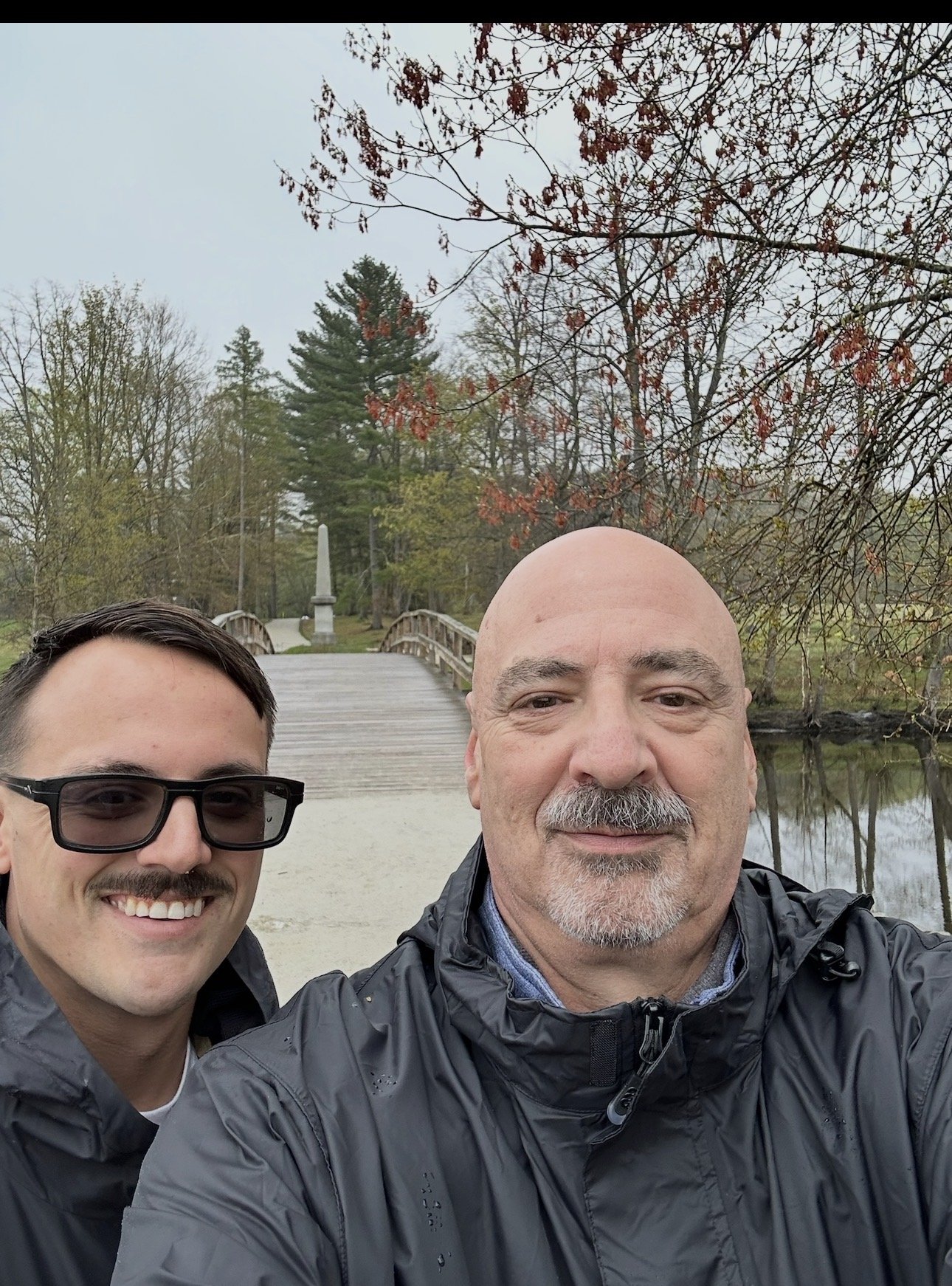
My youngest son Michael and I at the Old North Bridge in Concord, Massachusetts. Leadership is easier to understand when you stand where ordinary citizens made extraordinary decisions. Every visit reminds me that history is best experienced, not simply read.